On this page
Questions you could ask me
Questions you could ask me
What might earlier experience tell us today?
Or describe your own challengeIn around 2012, I presented a proposal to senior representatives of Norfolk’s emergency services for the Norfolk Resilience Forum website and mobile application. It was a competitive tender, and I wanted the panel to experience my proposed interface rather than simply hear me describe it.
I asked them to take out their phones and load a carefully prepared prototype. It was a demonstration of the proposed experience, not a finished application. On my journey home, I received the call confirming that Astutech had won the contract.
That moment captures a principle running through more than thirty years of my work: the most effective way to explain an idea is often to make it tangible.
Design was the beginning
Long before I was designing software architectures, I was interested in visual communication. My work included traditional illustration and airbrush techniques, branding, graphic design and the careful arrangement of information. Chromax Graphics was my own design business, and its original website used an airbrush illustration I had created before bringing it into that new medium.
When I moved into the web in 1994, I carried that discipline with me. Early work for Finnair, Coconut Software and other clients was as much about typography, navigation and human interaction as it was about programming. The technologies changed, but the habit of making complicated ideas understandable through design remained.
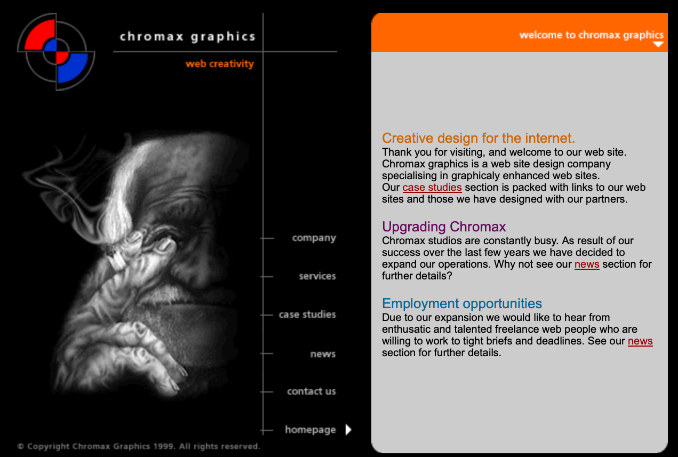
Before the web became ordinary
My background was in traditional illustration and graphic design, and I carried that visual discipline into my first website in early 1994. The early commercial web offered few established conventions, so good navigation, information structure and interaction often had to be developed through practical design and experimentation.
I went on to work on web projects for organisations including Fujitsu Europe and Finnair UK. But I was increasingly interested in a problem beyond producing websites: how could people manage information themselves without needing specialist technical knowledge?
Work involving publishing facilities for Members of Parliament helped lead to the development of a content management system that eventually became WordServer.
The underlying idea was straightforward. People should be able to concentrate on their information, not on the technical machinery required to publish it.
WordServer developed into a commercial product with paying customers. I retained the underlying intellectual property and continued developing the platform with my team.
It was an early lesson in designing technology around the people expected to use it.
Designing the experience — and the systems behind it
Throughout the following years, my work expanded across sectors and responsibilities.
In the early 2000s, I contributed user-interface development to an emerging commercial insurance aggregation system for professional brokers.
I subsequently worked on insurance technology with IW Consultancy, including development of its UnderwriteIT platform. I also created the UnderwriteIT name and branding.
These projects reinforced my interest in the relationship between complex business processes and the interfaces through which people interact with them.
Around the same period, I consulted for the Department of Trade and Industry on its Foresight 2020 web project.
The work involved sixteen departmental teams contributing their perspectives, priorities and concerns about the future.
I initially worked alongside a London agency. When that arrangement ended, I took responsibility for the visual design as well as the technical development.
I met regularly with senior civil servants in London, working to reconcile competing requirements while maintaining a coherent public-facing experience.
The project was delivered on time and within budget.
It taught me something that applies just as much to software architecture as to visual design: accommodating different requirements is not the same as allowing every requirement to dictate the solution.
A system still needs a coherent design.
Building relationships through delivery
Around 2004–2005, my company won a competitive tender to develop the Norfolk Fire Service website.
We went on to deliver and maintain it for several years.
The work extended beyond standard organisational information. It included public education, interactive material and games, and a live incident feed.
That experience was relevant when I later competed for the Norfolk Resilience Forum work.
I believe our established record with the Fire Service strengthened our position. The prototype helped communicate what we wanted to do next.
Both mattered: demonstrating that we could deliver, and helping stakeholders understand what we proposed to build.
Over the years, I’ve found that a successful project is more than a technical achievement. It is also the basis of trust.
Knowing when not to reinvent the wheel
By 2007, WordServer faced another substantial redevelopment as expectations around mobile devices and web publishing changed.
I could have invested in rebuilding the platform.
Instead, I looked at what WordPress had become.
It offered a maintained, flexible foundation for the kinds of solutions I wanted to develop. Continuing to own and maintain every part of my own CMS no longer made commercial or engineering sense.
So I adopted WordPress.
I learned to develop professionally with it and began using it for considerably more than conventional content management.
Since then, I’ve developed hundreds of websites and a handful of more sophisticated applications using the platform, including a substantial multi-customer workflow-management system built around a shared application core.
Some people were surprised that I would use WordPress for application development.
I was more interested in whether it could meet the requirements.
There is little value in reinventing something simply to demonstrate that you know how.
That doesn’t mean established platforms are always the right choice. Nor does it mean the most popular tool is necessarily the best.
I use what makes sense for the problem, the architecture and the people who will depend upon the result.
My development practices reflect that same approach. Some have their origins in methods I established before tools such as Git existed. I can work with Git when necessary, but I prefer different methods for my own projects.
I don’t claim they are universally better. They suit my requirements, particularly my preference for maintaining direct control over my source, intellectual property, release process and recovery arrangements.
Connecting the entire customer experience
For approximately sixteen years, I was involved in the ongoing development of digital systems for a major Ford dealership.
What began as a dealership website grew into a connected customer-facing platform.
Customers could search vehicle stock, configure optional extras, see updated prices and explore real-time finance calculations for arrangements including Hire Purchase, leasing and Personal Contract Purchase.
The work extended into vehicle ownership and customer relationships.
We developed a loyalty application designed to make communications more relevant to customers at different stages of ownership. That included service and MOT reminders, timely offers, replacement vehicle opportunities and connected finance information.
The aim wasn’t simply to add more features.
It was to bring together information and services that were useful at particular moments in a customer’s relationship with the business.
That experience reinforced an idea I’ve returned to repeatedly: a good system connects what people need to do, rather than making them navigate the boundaries between separate technologies.
Exploring what technology might become
Not every worthwhile piece of engineering becomes a commercial product.
I once worked with a company developing specialist active RFID location technology that could track tagged devices without relying on GPS.
I had a radio mast installed at my office and a couple of physical devices with which to experiment.
I built a functional tracking prototype and designed a separate, more polished mobile application exploring how the technology might be presented to consumers.
One potential application was protecting valuable agricultural equipment against theft.
But I was equally interested in the wider possibilities.
At one point, I attached a tracking device to the back of my office door to investigate whether movement could be detected remotely.
It was a simple experiment, but that’s often how useful ideas begin: a capability exists, somebody recognises another possible application, and a question becomes something testable.
The consumer application remained a prototype. The R&D and hardware experimentation were real.
I regard that distinction as important. Research does not need to become a commercial success to produce useful understanding.
Security, privacy and evidence
Between roughly 2016 and 2020, a substantial part of my work centred on website security, data protection and compliance.
The arrival of GDPR made these concerns more immediate for many organisations.
My security work typically began with an assessment, followed by remediation and independent checks using third-party tools.
Customers could inspect the results themselves.
I also recovered compromised websites and worked with organisations seeking to improve their information-security practices.
This developed into helping companies work towards ISO/IEC 27001 compliance.
Later, while working in Norway, I introduced related information-security practices within another organisation alongside my broader technical responsibilities.
The underlying principle was familiar: identify the problem, establish a baseline, make the necessary changes and gather evidence that the changes have worked.
A claim of improvement is more useful when somebody else can verify it.
Responding when circumstances change
Then COVID arrived.
The hospitality industry faced an immediate problem: how could venues continue serving customers while reducing unnecessary contact?
I turned my attention to BarWaiter, a mobile ordering solution intended to help hospitality businesses operate under those difficult conditions.
The product attracted interest, including discussions with representatives of Scandic Hotels about a potential wider rollout.
Those conversations also led to another experiment. Scandic representatives asked whether I could develop a cleaning-assessment application for hotel staff, including direct reporting and location-related features.
There was no contract. I developed a prototype because I was interested in the challenge and had the opportunity to explore it.
The wider commercial discussions did not ultimately lead to a rollout, amid the difficult circumstances of the pandemic and the loss of one of the people involved.
It was a reminder that commercial outcomes are influenced by factors beyond the quality of the software.
But the work itself demonstrated something I value: the ability to respond quickly, recognise a practical requirement and turn an idea into something people can examine.
From software systems to research
More recently, my work in Norway has included experimenting with digital-twin technology, sensor-related systems and geographic modelling.
One project involved developing a flood-risk digital-twin prototype to explore a different approach to an existing software problem.
It combined several interests that had developed throughout my career: location, complex data, systems architecture, visual communication and practical experimentation.
My current work with determinIQ brings together another set of longstanding concerns.
The central question is how people can explore and understand data while retaining confidence in the calculations, evidence and decisions behind the results.
I am developing determinIQ as a governed data-intelligence product in which analytical calculations remain deterministic and verifiable, while AI can help people express questions and understand results without becoming the authority for the analysis.
The development process itself has also become an area of research.
I’m exploring how human-directed, AI-assisted engineering can support substantial software development while keeping architectural decisions, requirements, verification and responsibility under human control.
For me, this isn’t about replacing the disciplines that make engineering dependable.
It’s about understanding how new capabilities can be incorporated without losing those disciplines.
The thread running through it all
Looking back, there is no single technology that defines my career.
I’ve worked with proprietary platforms and open-source frameworks, websites and mobile applications, insurance systems and emergency services, government stakeholders and independent businesses, experimental hardware and data-intelligence products.
I’ve designed interfaces, architected systems, written software, led development, won contracts, managed customer relationships and explored ideas that never progressed beyond research.
I’ve also had the benefit of working with talented colleagues and collaborators whose contributions have been essential to many of those outcomes.
The record includes competitively won contracts, commercial products, delivered systems, long-standing customer relationships and purposeful research. Each required judgement about the problem, the people involved and what the outcome needed to achieve.
The consistent element has been my interest in understanding a problem deeply enough to see how technology might make a useful difference.
Sometimes that means building something entirely new.
Sometimes it means recognising that an existing solution is already good enough.
Sometimes it means challenging an established convention. Sometimes it means retaining a practice that continues to work.
And often, it means bringing together the technical, human and commercial parts of a problem that are too easily treated as separate concerns.
I don’t believe engineering is defined by the complexity of the tools we use, or by our willingness to follow convention.
I believe it is demonstrated through the quality of our decisions, the usefulness of what we produce, and our willingness to examine the results.
After more than thirty years, I am still curious about what technology can make possible.
And I’m still happiest when somebody describes a difficult problem and I can say:
I see what you mean.
From idea to reality.
Historical context
Research programme: From intention to implementation: human-directed AI-assisted engineering
Topic: Foundations
Explore further
Further reading is listed below.