On this page
For approximately sixteen years, from around 2000 to 2016, I worked with Busseys as its digital services evolved from an early dealership website into a much broader set of connected customer and business applications.
Through Astutech, I helped design and engineer vehicle inventory and search, configuration and pricing, finance options, customer services and, later, the Busseys Family mobile application. This was sustained work across the customer journey, not a succession of unrelated website redesigns.
A platform that changed over time
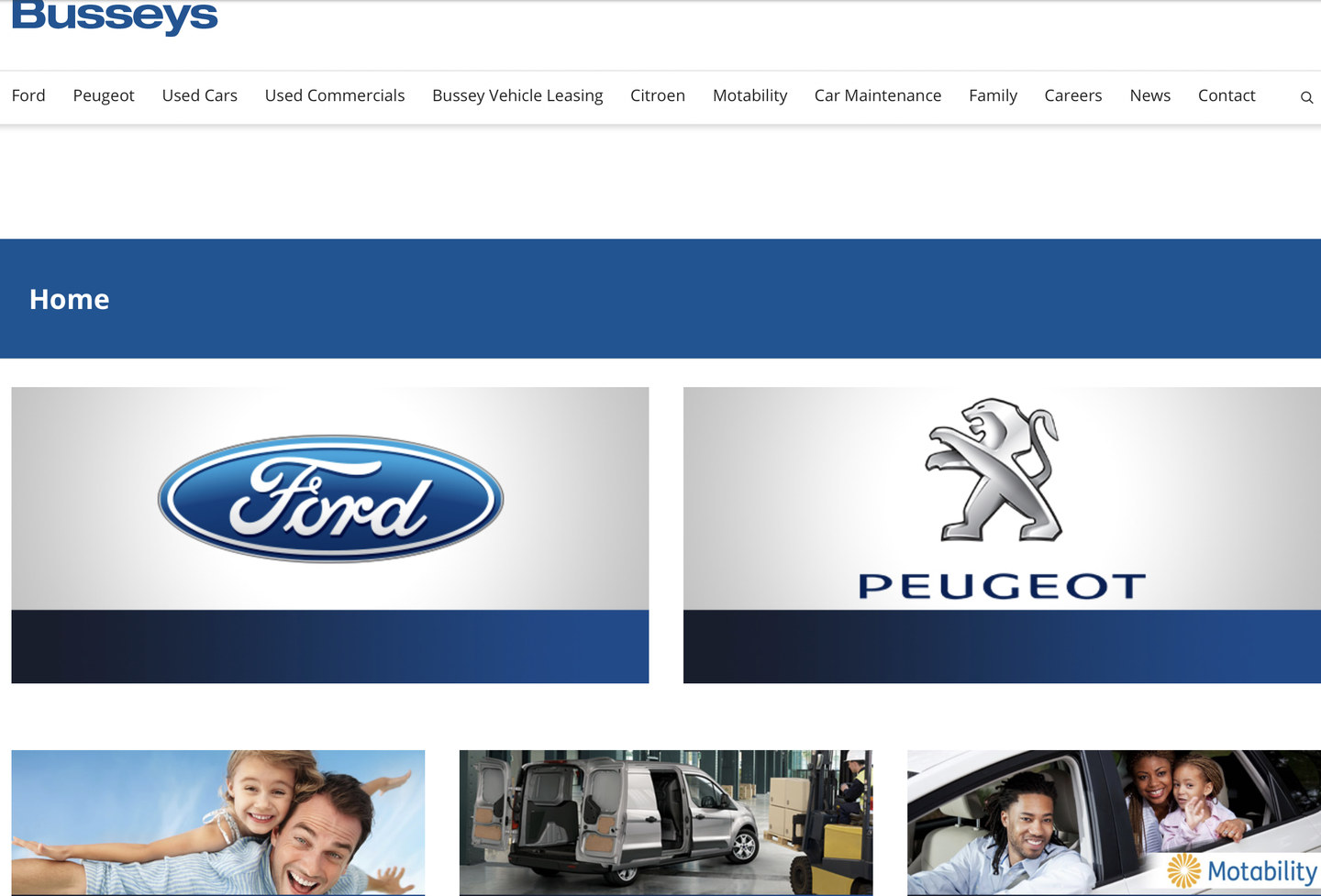
The surviving Busseys websites provide a useful record of that progression. An early 2001 design offered vehicle searches, a way to build a Ford to specification, and services such as maintenance booking and vehicle valuations. By 2006–2007 the website was organised around new and used vehicles, commercial vehicles, parts, servicing and wider customer services. The archived footer identifies Astutech as the designer and WordServer as the publishing platform.
Later versions made room for more brands, finance and leasing choices, and separate specialist services. Comparing the interfaces is a reminder that digital development for an established business is rarely one finished design. The customer, the business and the capabilities of the technology keep changing.
The screenshots document the public-facing evolution; they do not, by themselves, establish the implementation state of every back-office connection on each archive date.
From browsing to choosing
A dealership website needs to do more than display attractive pictures of cars.
Customers want to find vehicles that meet their requirements. They need to compare options, understand specifications and establish what they can afford.
We developed vehicle-search and configuration functionality that supported those decisions.
Customers could explore vehicle stock and choose optional extras, with the selected configuration affecting the displayed price.
But the purchase price was only part of the decision.
Different finance arrangements could make the same vehicle appear quite different in terms of monthly commitments, contractual structure and eventual ownership.
So the configuration experience also supported real-time finance calculations.
Customers could explore options including Hire Purchase, leasing and Personal Contract Purchase, with calculations connected to the dealership’s finance arrangements.
The aim was to make the relationship between the vehicle, its specification, its price and its financing understandable within the same customer journey.
The wider ownership relationship
The development work subsequently extended into a customer loyalty mobile application.
The interesting challenge was that customers’ requirements change over the lifetime of a vehicle.
Someone who has recently bought a new car may need information about servicing or routine maintenance.
Someone approaching the point at which they might replace that vehicle could be interested in a different offer.
A generic promotion sent to every customer would be less relevant than communication informed by where that person was in the ownership lifecycle.
The application was designed to support that more considered approach.
It included service and MOT reminders, booking-related functionality, relevant offers and opportunities to explore replacement vehicles.
Customer groups could be organised according to information such as ownership stage and other available customer characteristics, supporting more timely and targeted communications.
Finance calculations were also part of that connected experience.
The intention was to make the application genuinely useful to customers rather than simply another channel through which the dealership could advertise.
Busseys Family: the application behind the relationship
An archived Astutech case study describes the larger product in more detail. The solution included iOS and Android applications, a responsive web alternative, back-office administration and a separate dealer-video application. These formed part of an established loyalty programme rather than a standalone promotional app.
The documented capabilities included a vehicle glovebox with ownership-related information, service and MOT reminders, booking, breakdown assistance, vehicle valuation requests and targeted customer communications. An accident-recording facility could gather location-aware photographs, video and audio as part of a structured record.
Astutech’s contemporary case study reported more than 500 users of the loyalty application at that point. This is not the same as the many thousands of members of the wider Busseys Family loyalty programme, and the two figures should not be conflated.
The separate DataDrive motor-claims venture emerged from an earlier line of incident-reporting work. Although the subject matter overlaps, I would not treat the Busseys Family incident feature and DataDrive as the same implementation without further evidence.
Connecting information that already existed
Much of the challenge in projects of this kind lies in bringing together information from different business activities.
Vehicle stock, configurations, finance arrangements, customer relationships and service requirements serve different purposes within a dealership.
But customers don’t necessarily see them as separate systems.
They see one business with which they have an ongoing relationship.
That difference in perspective matters.
An application can be technically correct within the boundaries of an individual department and still be awkward for the person using it.
I designed the customer-facing experience and contributed substantially to the underlying engineering, working alongside my team and the dealership’s people. Understanding how the separate services fitted together was central to the architecture.
It was another example of my preference for designing the system and its interface as parts of the same problem.
Extending the approach
The loyalty application attracted interest beyond the original dealership, leading to related work with another major UK dealership.
That further interest showed that the approach had relevance beyond the original customer, while leaving room to adapt it to another dealership’s processes and systems.
But the broader problem is familiar: customer information and business capabilities are often distributed across systems that were never designed around the complete customer experience.
The lesson
What I remember most from this work isn’t a particular screen or feature.
It’s the importance of connecting the different stages of a customer’s relationship with a business.
The vehicle configurator was useful because it brought specification, price and finance into the same decision.
The loyalty application extended that thinking into ownership, maintenance and replacement.
Both reduced the need for customers to understand the internal boundaries of the dealership’s systems.
A good customer experience is often the result of engineering those boundaries out of the way.
That principle applies far beyond automotive retail.
Project context
Topic: Automotive
Explore further
Further reading is listed below.