On this page
Questions you could ask me
Browser-side protection. Governed ingestion. Controlled rehydration.
Protecting personal information is not simply a matter of hiding names in a table. The more consequential question is what a system receives, how it recognises the meaning of unfamiliar data, and whether the information remains useful once original identities have been protected.
In determinIQ I designed a connected journey from reviewing source data in the browser to working with its protected representation and, where the local browser holds the relevant protection material, displaying original labels again. The work joins privacy engineering to product architecture, field semantics and user experience.
The governing design decision
Protect before ordinary server-side analysis. Preserve the relationships needed for supported calculations, without giving the analytical environment a general route back to original personal labels. A browser-local reveal changes presentation, not the result of a governed calculation.
The images below come from several synthetic local test sessions, not a single uninterrupted upload. The application-reported figures and statuses illustrate tested behaviour; they are not an independent security certification or a claim of commercial deployment.
The protection boundary comes first
Many datasets combine identity-bearing fields with numerical measures and legitimate grouping requirements. Removing every personal identifier can make certain useful questions impossible to answer; retaining every original value throughout the system creates a different and avoidable exposure.
determinIQ uses a browser-side protection boundary. The product’s Data Protection view explains the intended division: original values are handled locally, the server receives a protected representation for supported analysis, and any permitted reconstruction of readable labels is performed by a browser that still holds the corresponding local material.
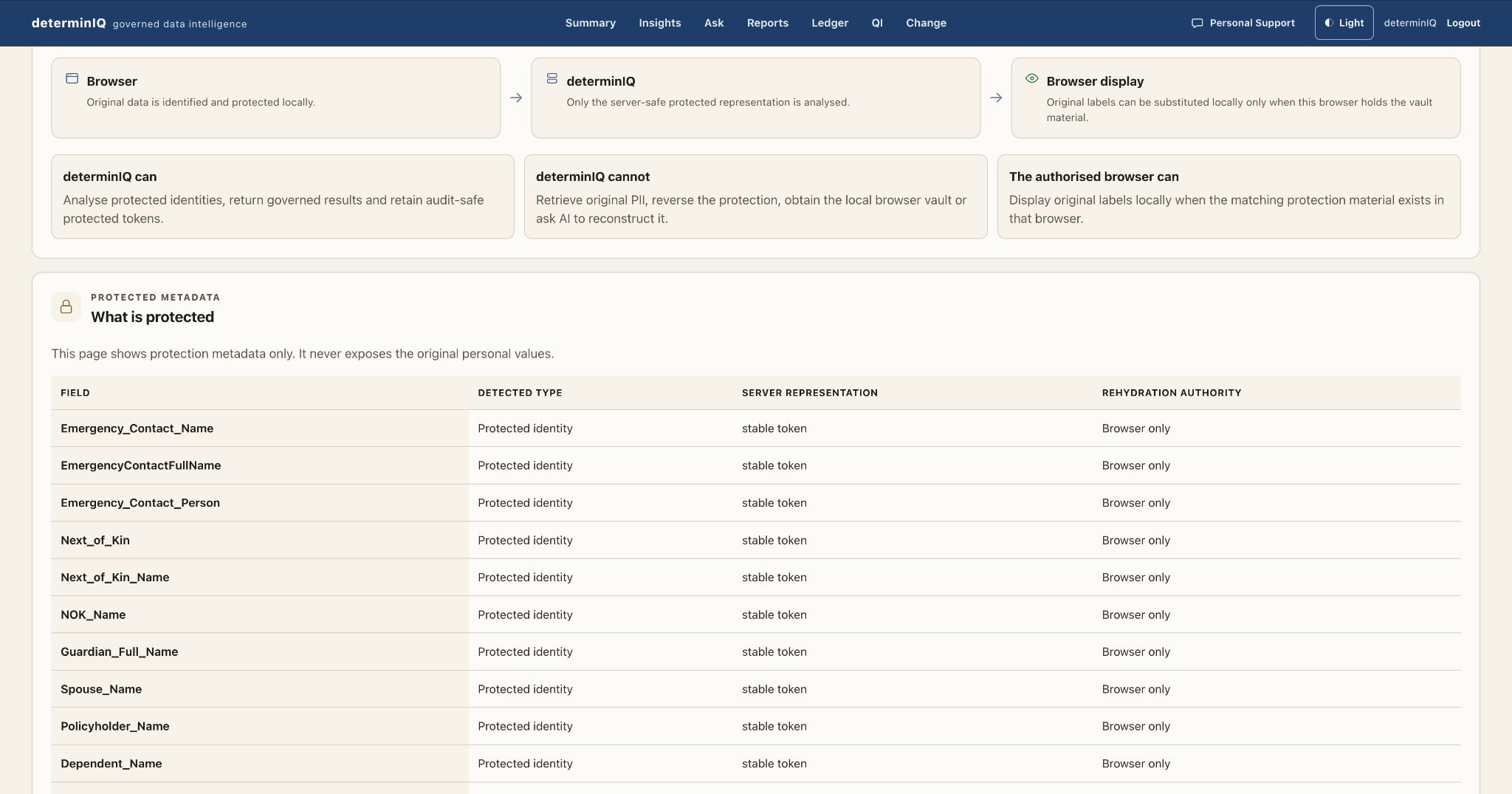
That separation must apply beyond the obvious data table. Questions, chart labels, reports, exports and historical results can all become routes through which a protected value is accidentally redisplayed. The architecture is useful only if the same responsibilities are maintained across those surfaces.
What the demonstration shows at scale
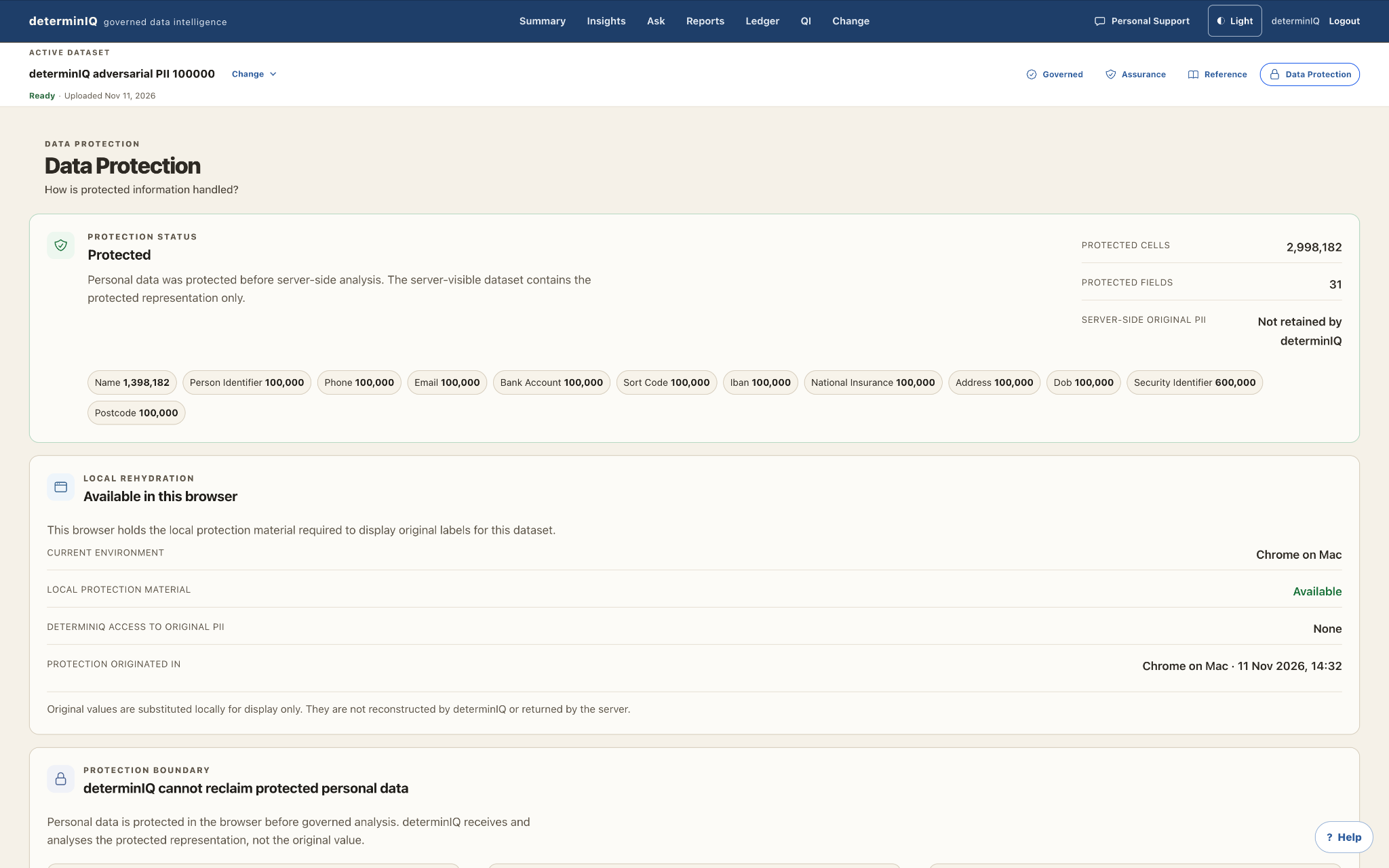
One synthetic adversarial dataset contains 100,000 records. The Data Protection screen reports 31 protected fields and 2,998,182 protected cells, while identifying the active browser as the holder of local protection material. Those numbers describe the state reported by that local application test, not an independently assessed security outcome or a system-wide performance guarantee.
Understanding the data before using it
A column heading can suggest its purpose without establishing it. A transaction code may be an identifier rather than a numerical measure. Negative quantities may represent returns, corrections or something else. A date format may be ambiguous. Treating any of those guesses as analytical authority can produce a perfectly calculated answer to the wrong question.
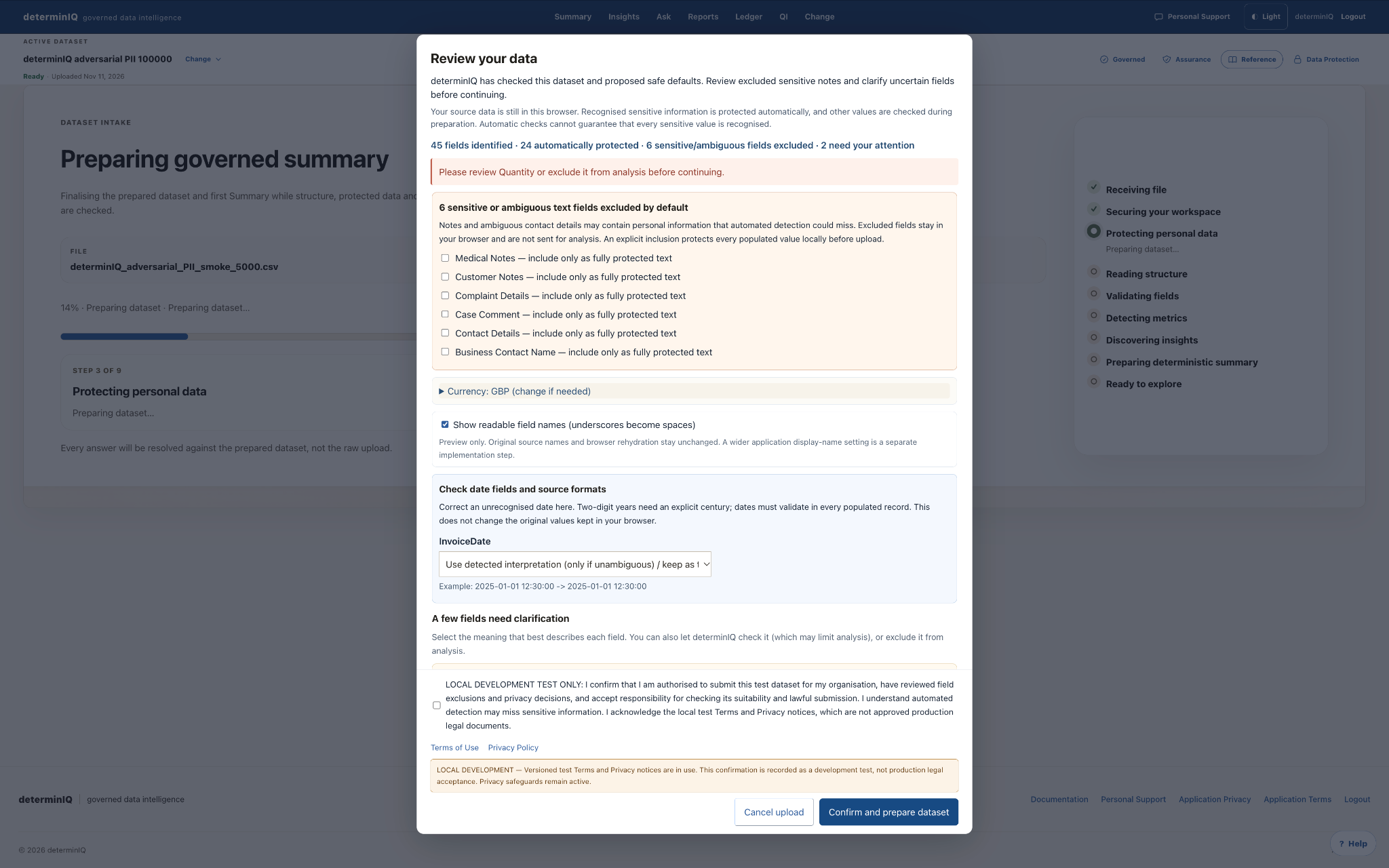
The ingestion review identifies fields, proposes interpretations, applies automatic protection where recognised and asks the user to resolve meaning when needed. It offers choices such as identifier, category, ordered category, quantity, price or monetary amount, while making clear that those choices remain subject to later system checks.
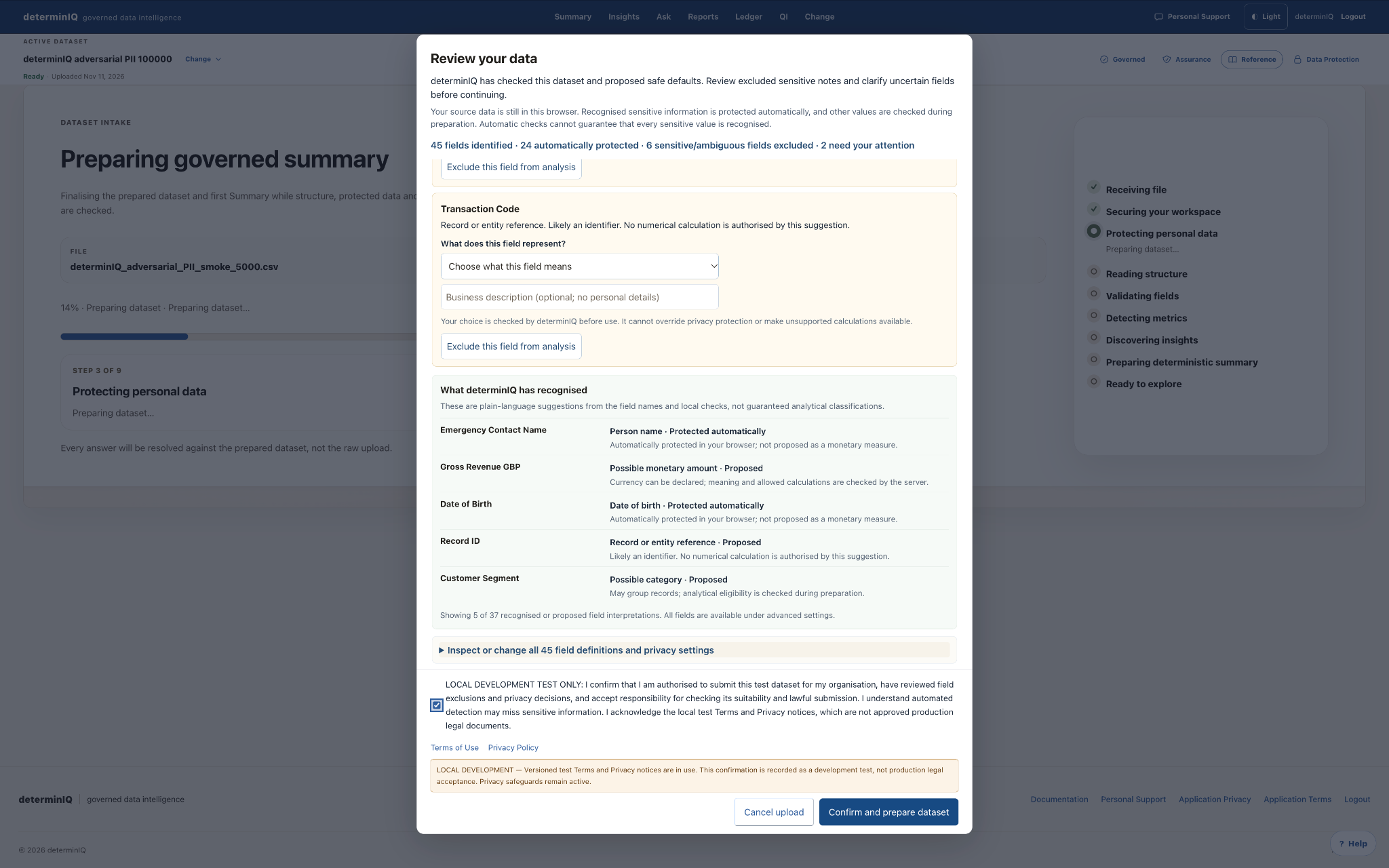
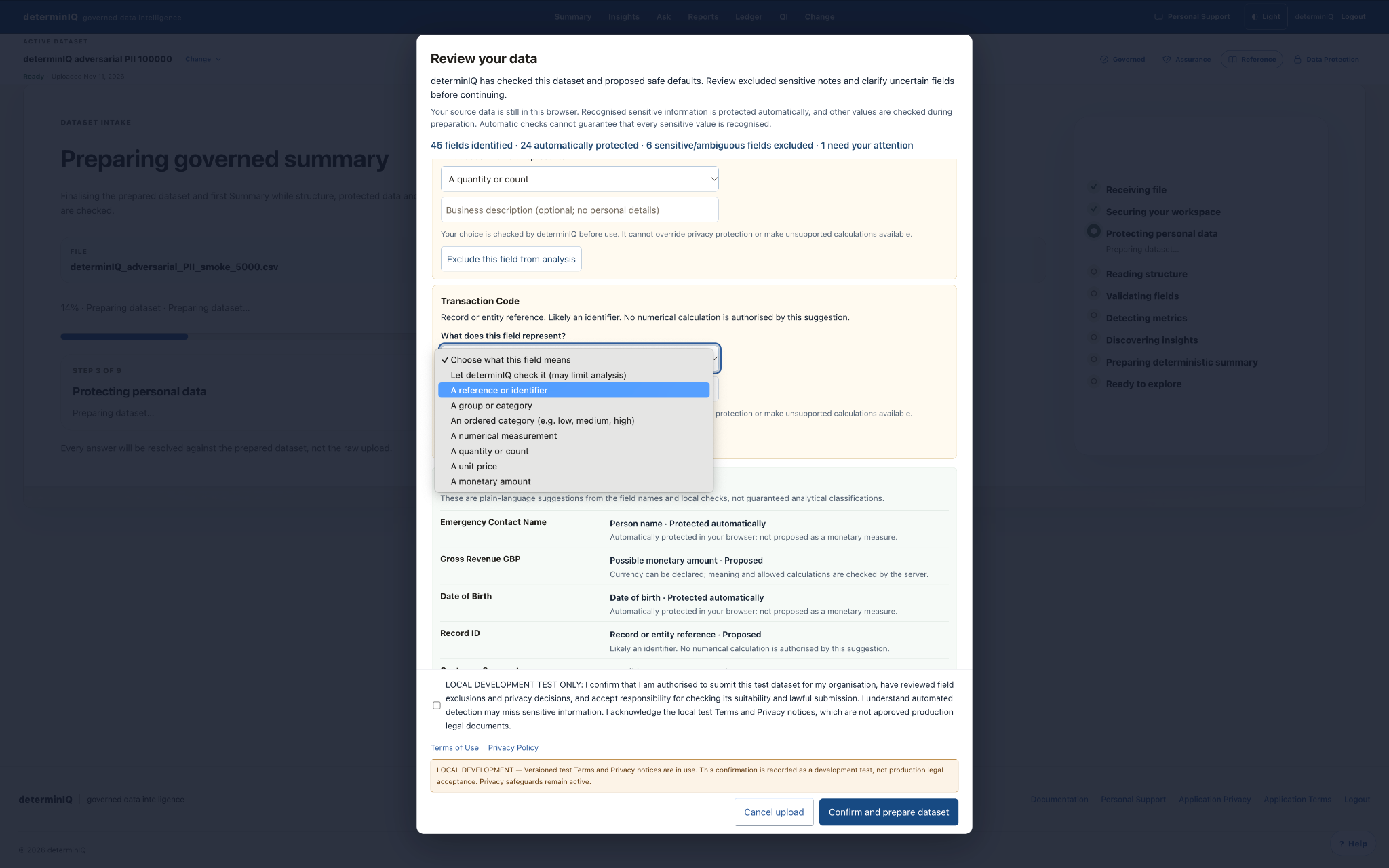
Free-text material deserves different treatment. Notes, contact details and other ambiguous fields may include sensitive information that field-name detection cannot reliably identify. The review shows six sensitive or ambiguous fields excluded by default, with deliberate inclusion requiring protected handling rather than an assumption that such text is harmless.
Correct arithmetic requires a correct meaning
Field definitions are not cosmetic metadata. They influence whether a calculation is eligible, what it means and what the application may safely say about it. Human confirmation is valuable precisely where the data cannot establish its own business meaning.
Protected does not mean unusable
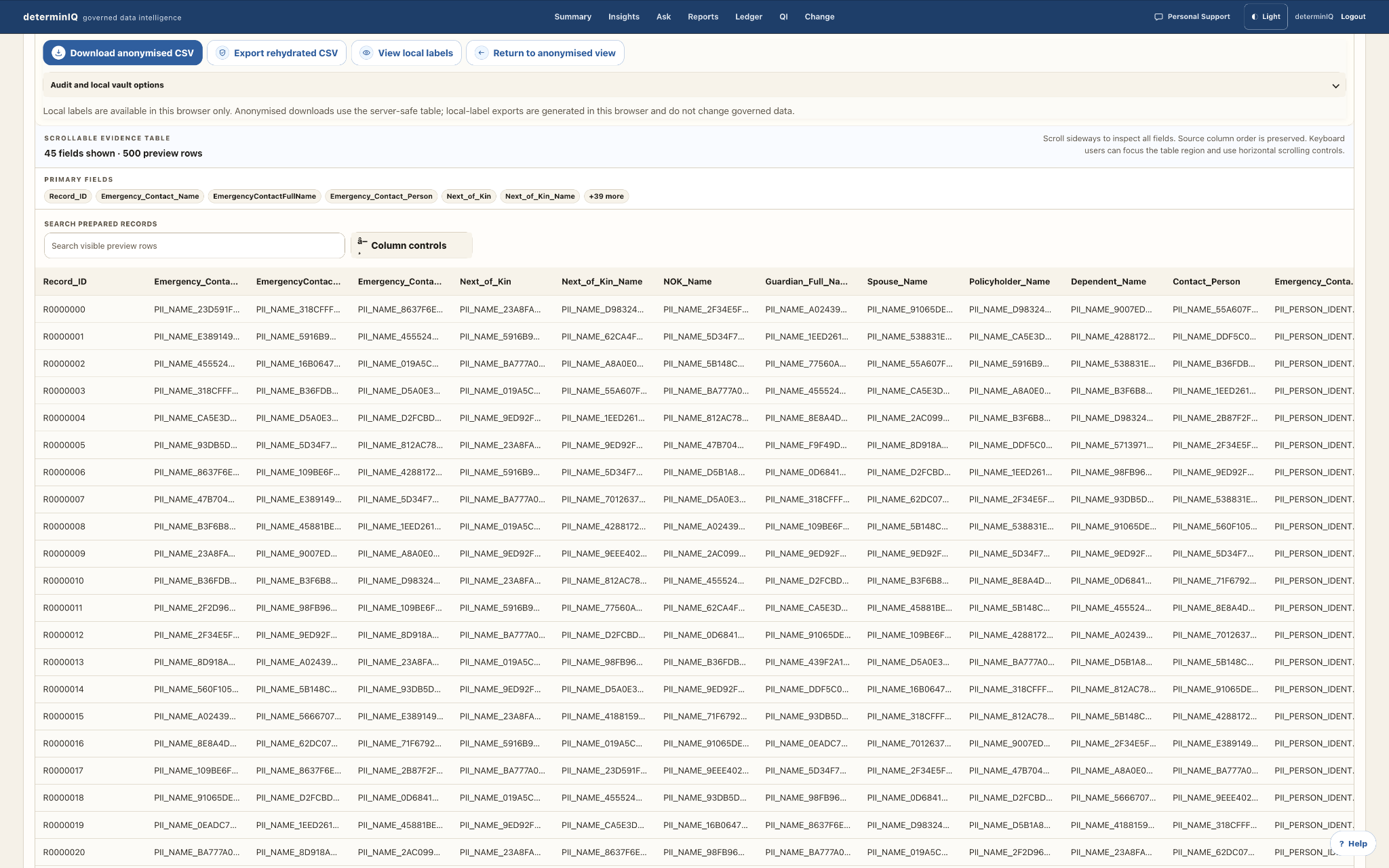
A prepared-records view shows the server-safe form of the dataset: stable identity tokens in place of original names. Such tokens can preserve relationships among records for supported grouping and ranking, while leaving the original labels outside the analytical representation.
This is pseudonymisation, not irreversible anonymisation: the corresponding original identity can still be made readable by a browser holding the authorised local material. That distinction matters whenever the product describes its privacy behaviour.
Protected for analysis. Readable when authorised.
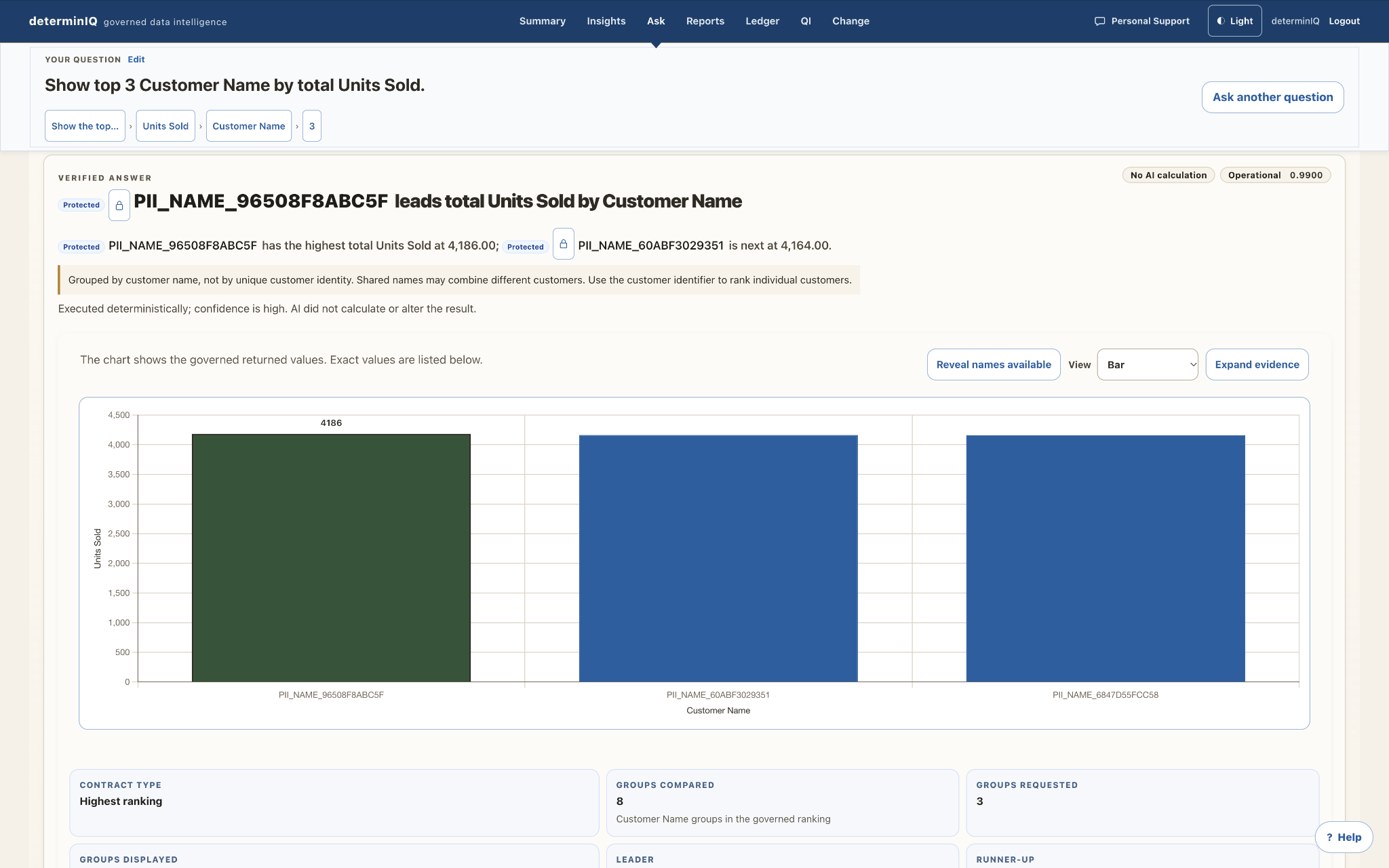
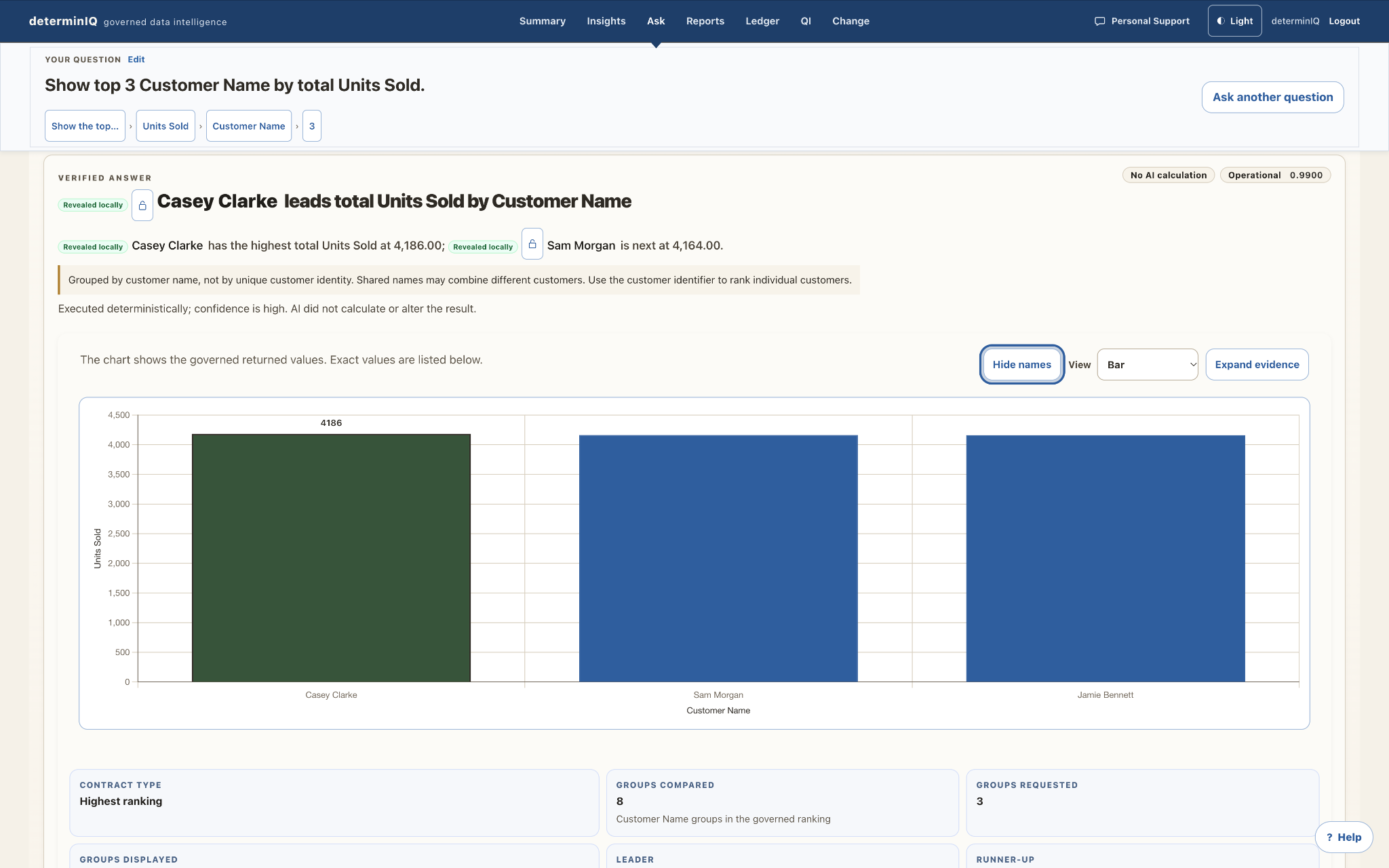
The clearest demonstration is a verified Ask result. The question requests the three customer-name groups with the highest total Units Sold. The protected presentation shows tokens in the heading, explanatory sentence and chart axis. The local-reveal presentation displays readable names in those same places.
The governed figures remain unchanged. Casey Clarke’s name group leads with 4,186 units, followed by Sam Morgan’s with 4,164 units. Eight name groups were compared and three displayed. The interface also explains a crucial limitation: grouping by customer name is not the same as grouping by a unique customer identity. Shared names may combine more than one customer; a customer identifier is needed when the intention is to rank individuals.
Both views show the same verified result. The application states that AI did not calculate or alter the calculation; each image links to its complete screenshot.
01 / Protected analytical result
02 / The same result with local names
The calculation does not change. The presentation does.
Protected tokens and locally revealed names refer to the same analytical groups. The authorised browser changes how identities are displayed; it does not rerun the governed analysis or ask AI to reconstruct the names.
The screenshots establish the visible behaviour of this demonstration. They do not, by themselves, prove the absence of every possible disclosure path. That requires ongoing boundary, export, logging and browser acceptance testing.
Designing the complete experience, not just a protection routine
What matters to this project is the connection between the design choices. Protection affects ingestion. Ingestion depends on field meaning. A correct ranking depends on the grouping key. The result then needs to remain both inspectable and appropriately readable in tables, charts, narrative and saved views.
I conceived and developed these parts of determinIQ as one product, taking responsibility for the concept, privacy and analytical boundaries, information architecture, interaction design, implementation direction, engineering review and testing, with GPT assisting the development process.
What this demonstrates about my work
The value is in maintaining responsibility across the whole journey: understanding the risk, defining the architectural boundary, making the controls usable, and checking that the implementation behaves accordingly. This is a systems and product-design challenge as much as a privacy-engineering one.
Research context
Development stage: Working implementation
Research programme: Making data analysis understandable, reproducible and accountable
Topic: Evidence and accountability
Explore further
Further reading is listed below.