On this page
Questions you could ask me
Questions you could ask me
What would trustworthy analytics mean for you?
Or describe your own challengeDeterministic execution. Verifiable evidence. Human accountability.
How can the flexibility of AI-assisted interaction make complex analysis easier to use without surrendering responsibility for the calculations and results? That question became the starting point for determinIQ: a governed data-intelligence application conceived, designed and developed as an integrated working product.
My contribution: concept, product direction, brand, user experience, interface design, architecture, engineering, review and testing, working with GPT as a development assistant throughout. Project status: evolving working product and research programme; the examples shown are internal demonstrations, not claims of independent certification or commercial deployment.
Trust has to be designed into the process
An analytical answer can sound convincing even when the question has been misunderstood, the calculation is unsuitable or the evidence cannot be examined. I wanted to make natural-language interaction approachable while ensuring that analytical authority remained with controlled, deterministic processes.
That architectural decision shaped the whole application. Language assistance helps with questions and explanation; governed analytical operations perform supported calculations and preserve their basis. But a working product also has to support the people using it: from beginning an investigation to understanding, checking and communicating the result.
Three connected responsibilities
Architecture: define what AI may assist with and what remains under deterministic analytical authority.
Development: maintain human direction, inspect the actual implementation and verify its behaviour while working with GPT.
Outcomes: let people examine the evidence, assumptions and limits of what a result establishes.
Designing the experience, not just the engine
I took responsibility for the product’s identity, interaction model, interface and underlying implementation as connected parts of the same system. The experience offers different starting points: a business question, a guided investigation, a summary of the available data or a recorded finding. These are design responses to the fact that people do not always arrive knowing exactly what to ask.
The example here uses Aster & Finch, a fictional apparel retailer, with six synthetic monthly datasets covering January to June 2026. Each contains 25,000 records: 150,000 in the six-month demonstration. This gives the reader a familiar setting in which to follow the product’s behaviour.
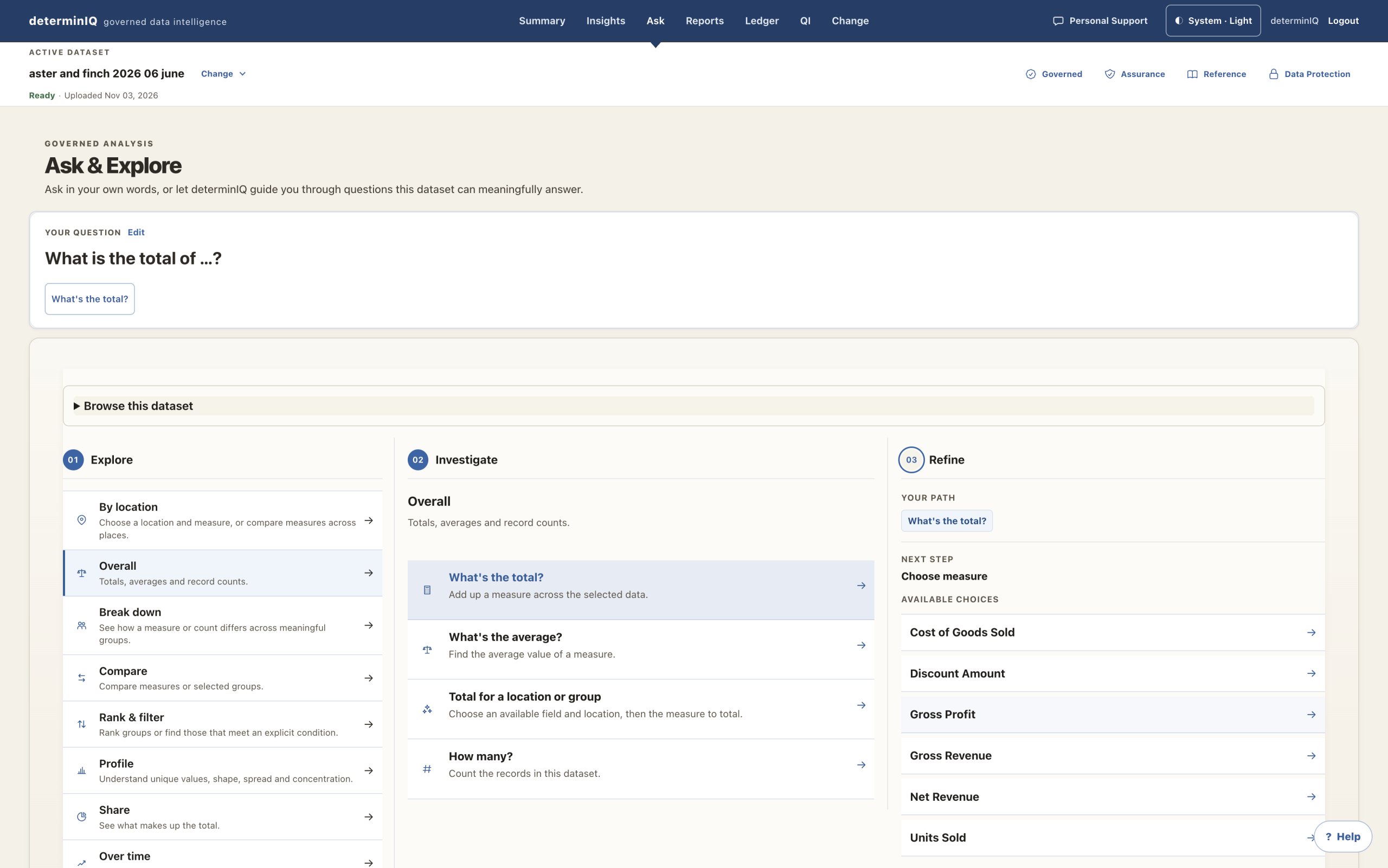
A business question: what actually changed?
In the May-to-June snapshot comparison, Summary brings forward two movements worth investigating. The figures are generated from synthetic data; they are not actual trading results. Rather than presenting the movement as an explanation, the interface provides a starting point for further inquiry.
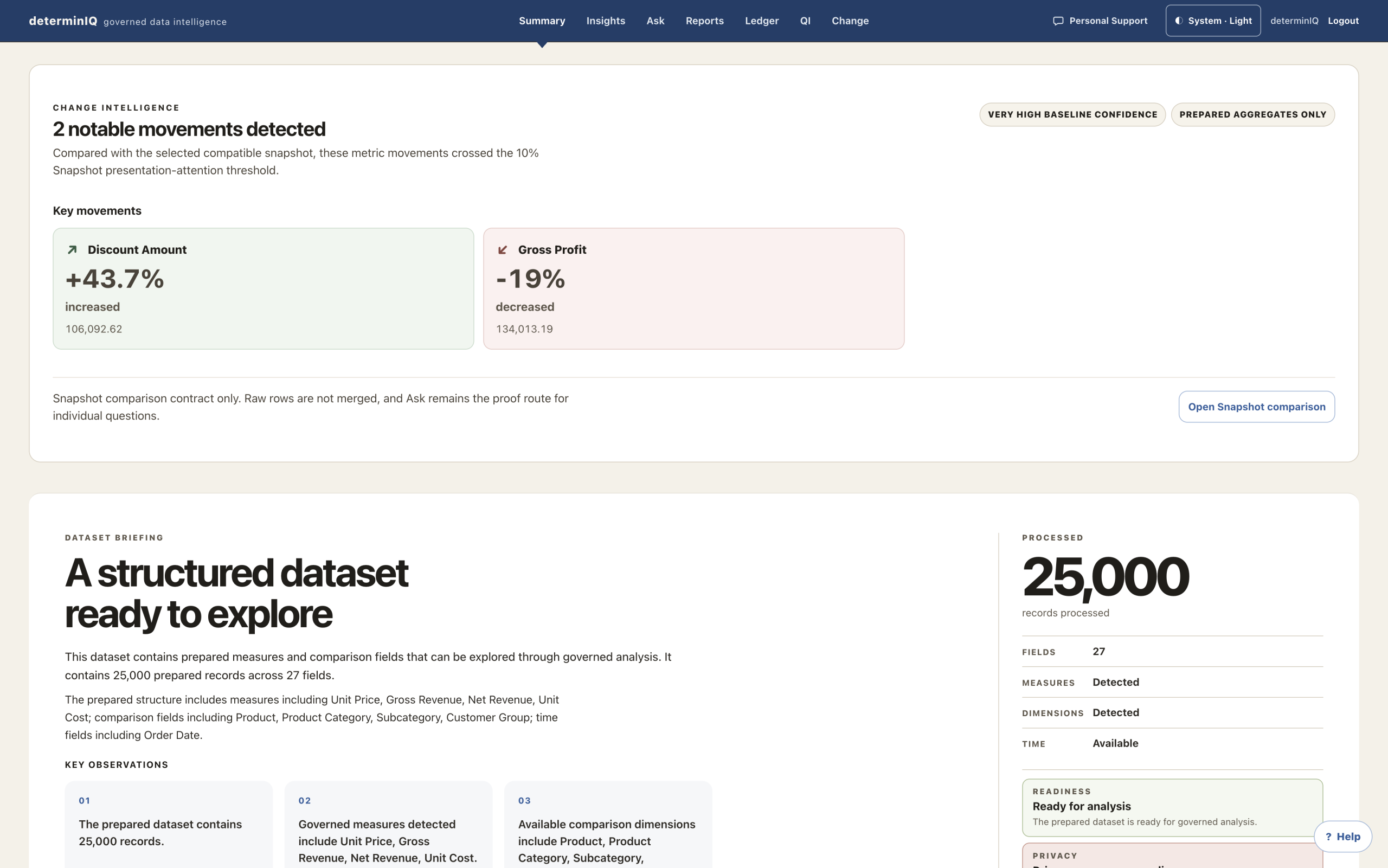
An observation is not an explanation
Discount Amount increased by 43.7%, while Gross Profit decreased by 19% in the selected comparison. The two movements are worth examining together, but they do not establish that one caused the other. That distinction is central to the way determinIQ is intended to support investigation.
Six monthly snapshots also make it possible to look beyond a single before-and-after comparison and inspect how related measures developed over time.
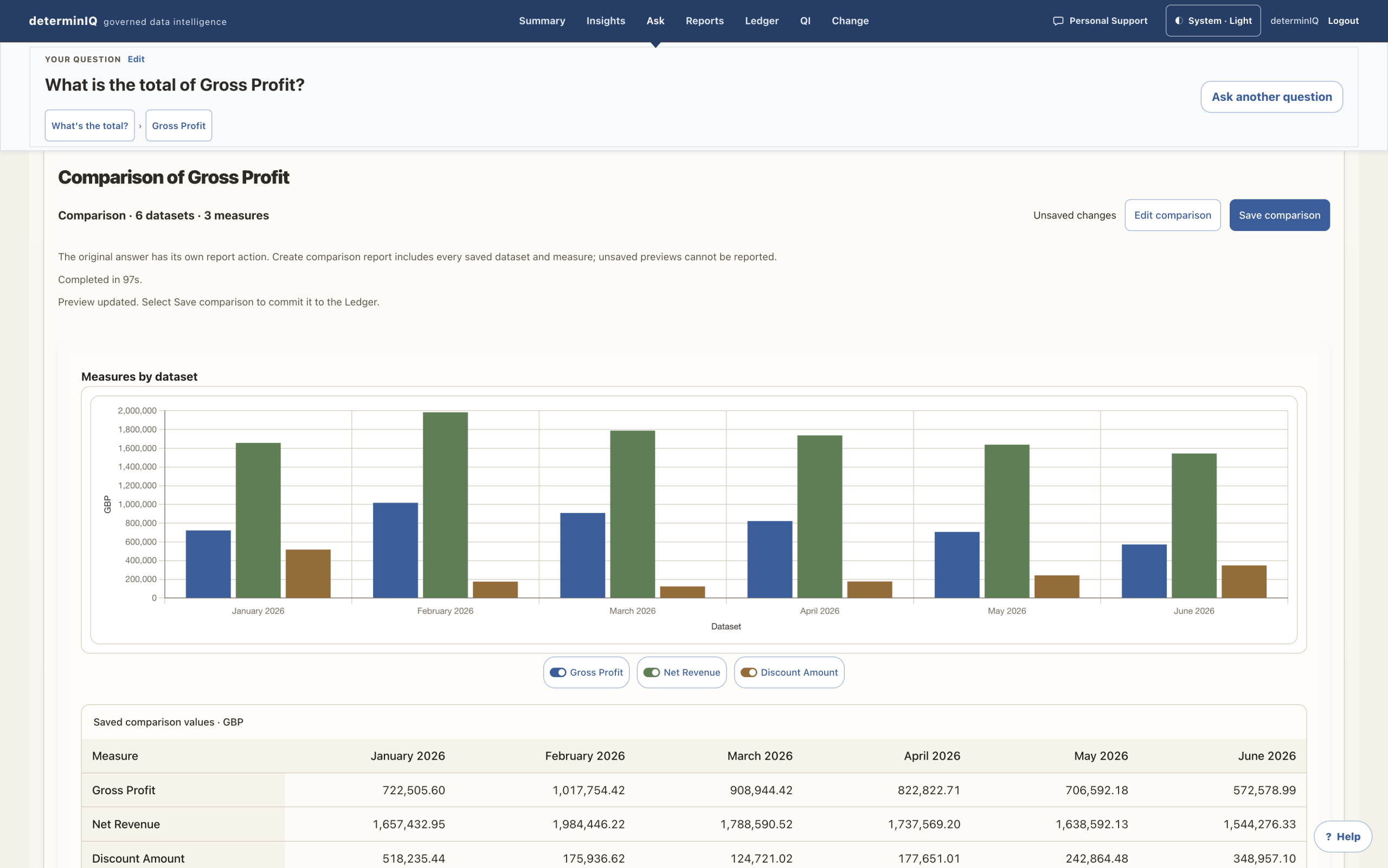
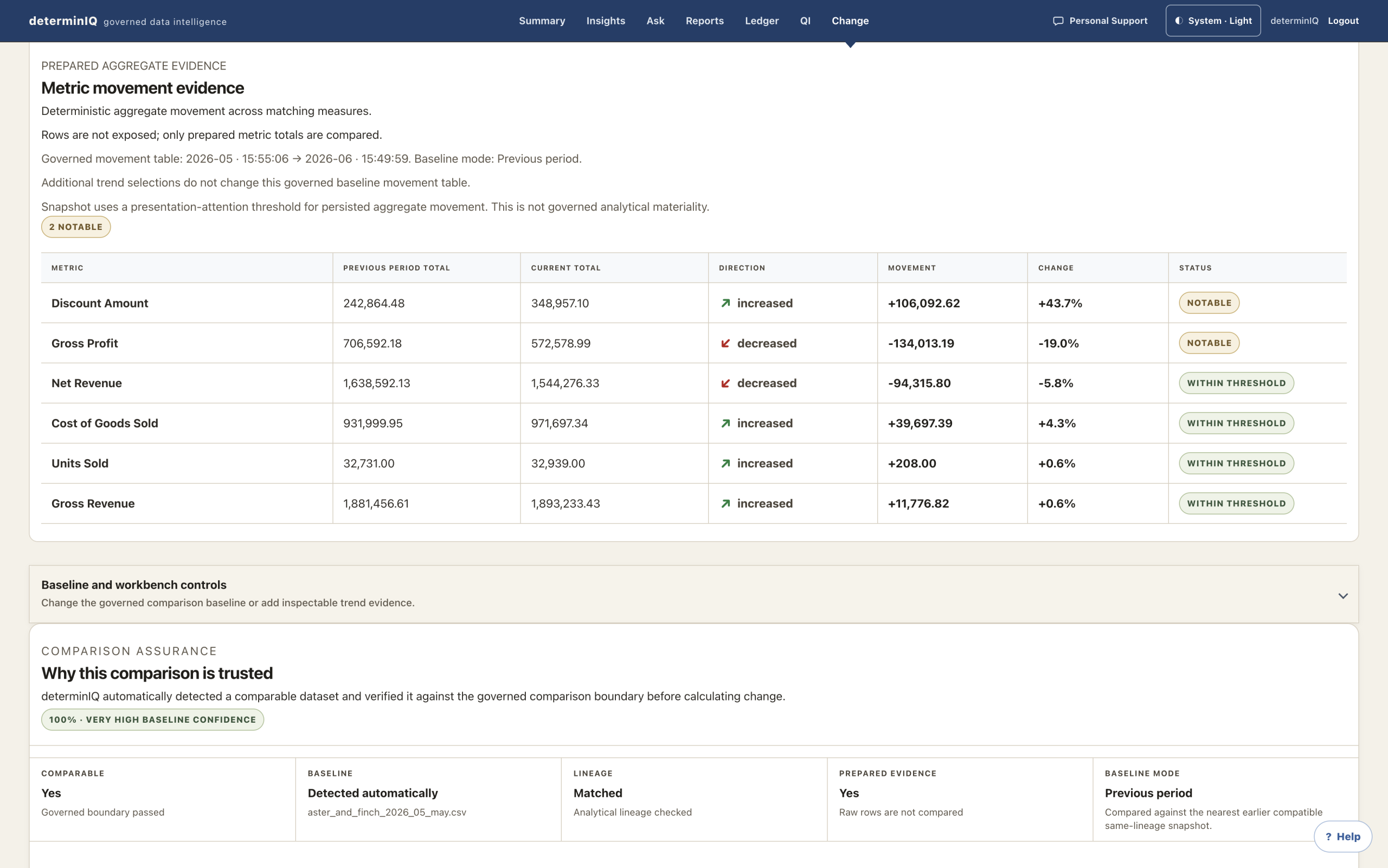
Evidence belongs beside the result
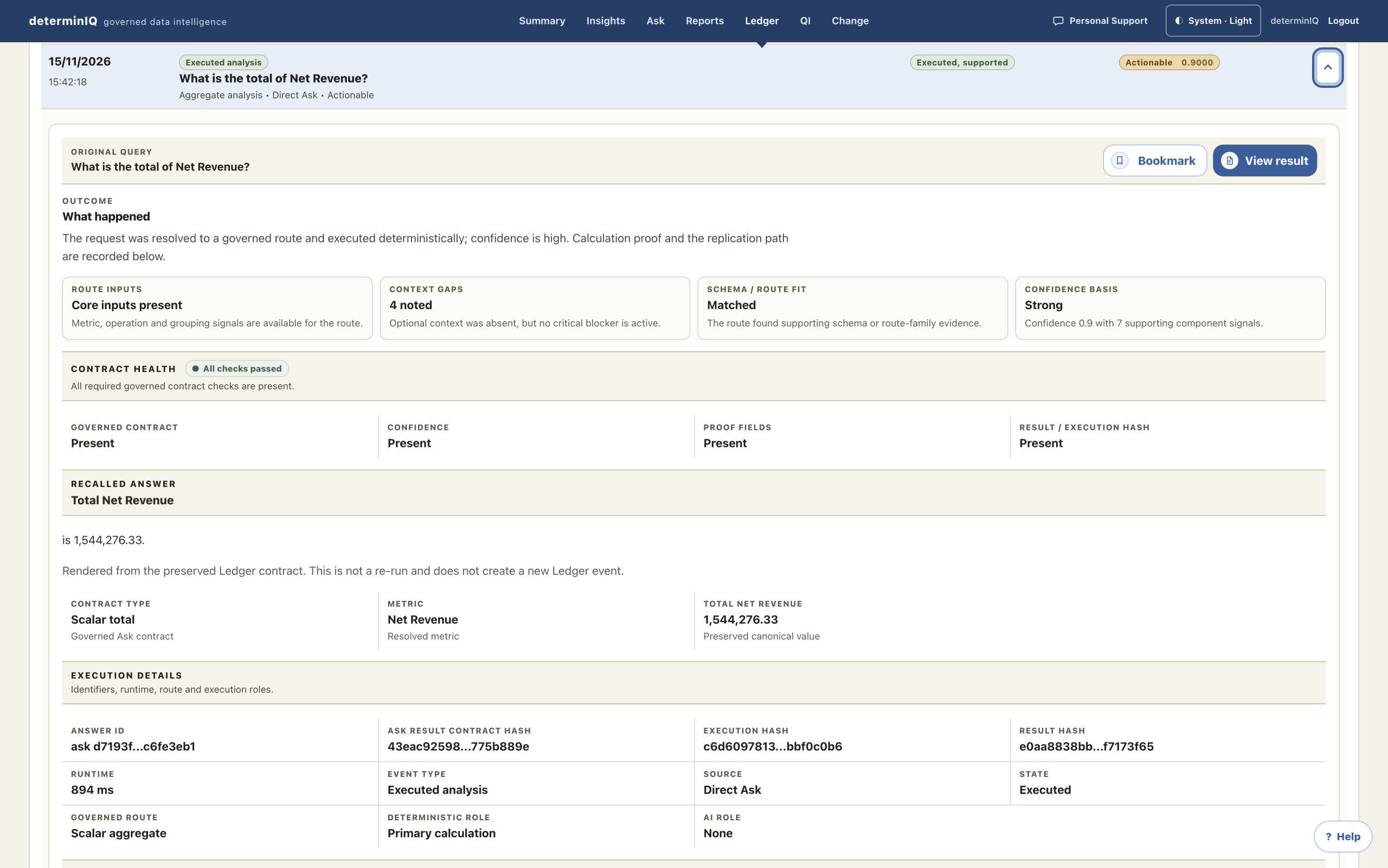
A chart communicates movement quickly, but its usefulness depends on the comparison behind it. The Change view presents the baseline, current values, direction and scale of movement, alongside the context of the comparison. The Ledger provides a route back to the execution details of recorded analyses.
These facilities are not separate administrative additions. They follow from the design decision that analytical results should remain open to inspection after their first presentation. The movement view and Ledger example below show different parts of that approach; the Ledger capture is a Net Revenue result, not evidence of a causal explanation for the discount/profit movement.
From finding to a report someone can use
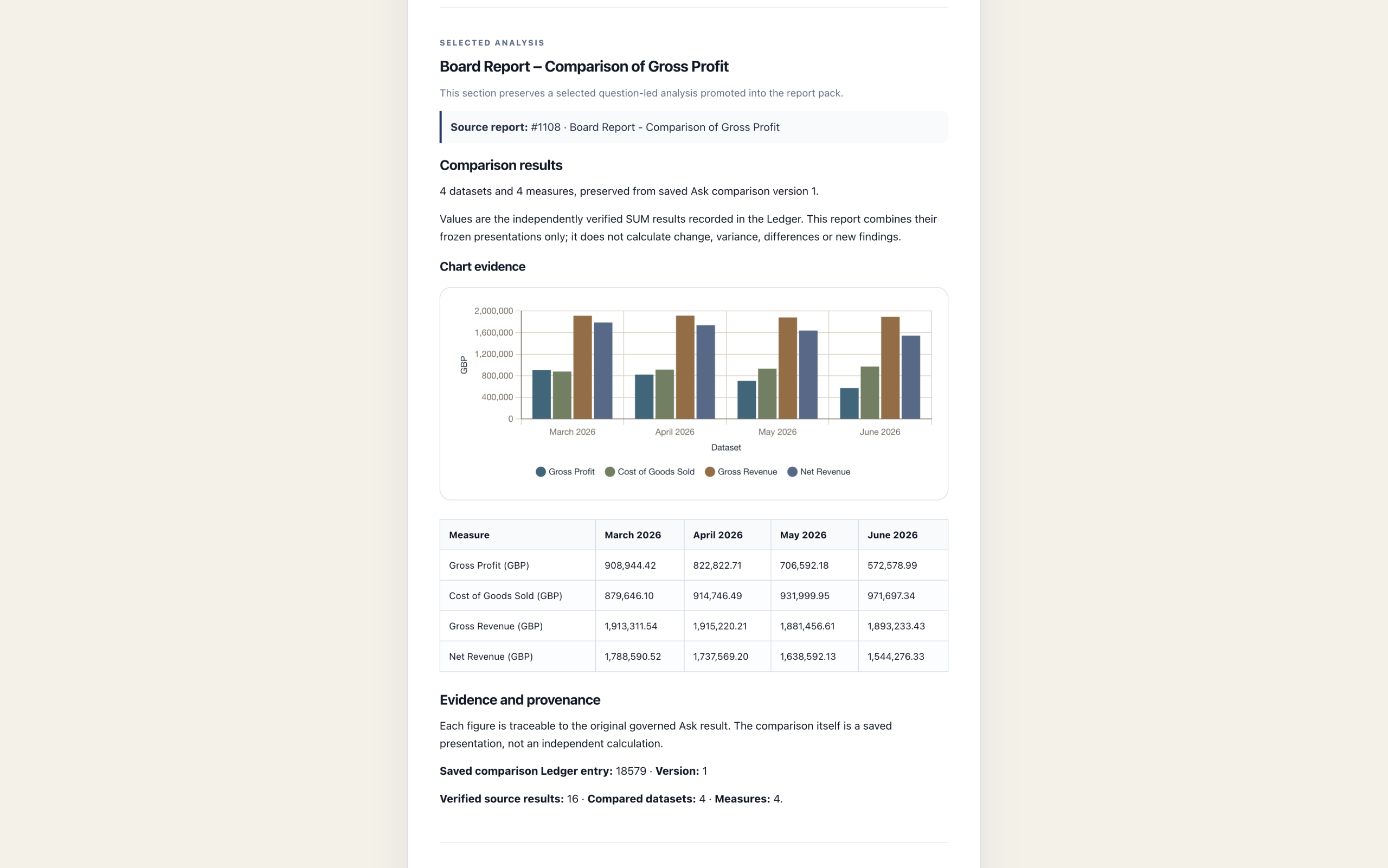
Analysis often needs to travel beyond the person who performed it. The reporting workflow can bring selected results together into a structured presentation. The pictured report contains a comparison chart, underlying values and information about its evidence.
The report’s March–June comparison is not the same view as the January–June comparison above. It also distinguishes a saved presentation of source results from an entirely new calculation. That separation matters: attractive reporting should not become another, unexamined analytical authority.
Privacy is part of the user journey
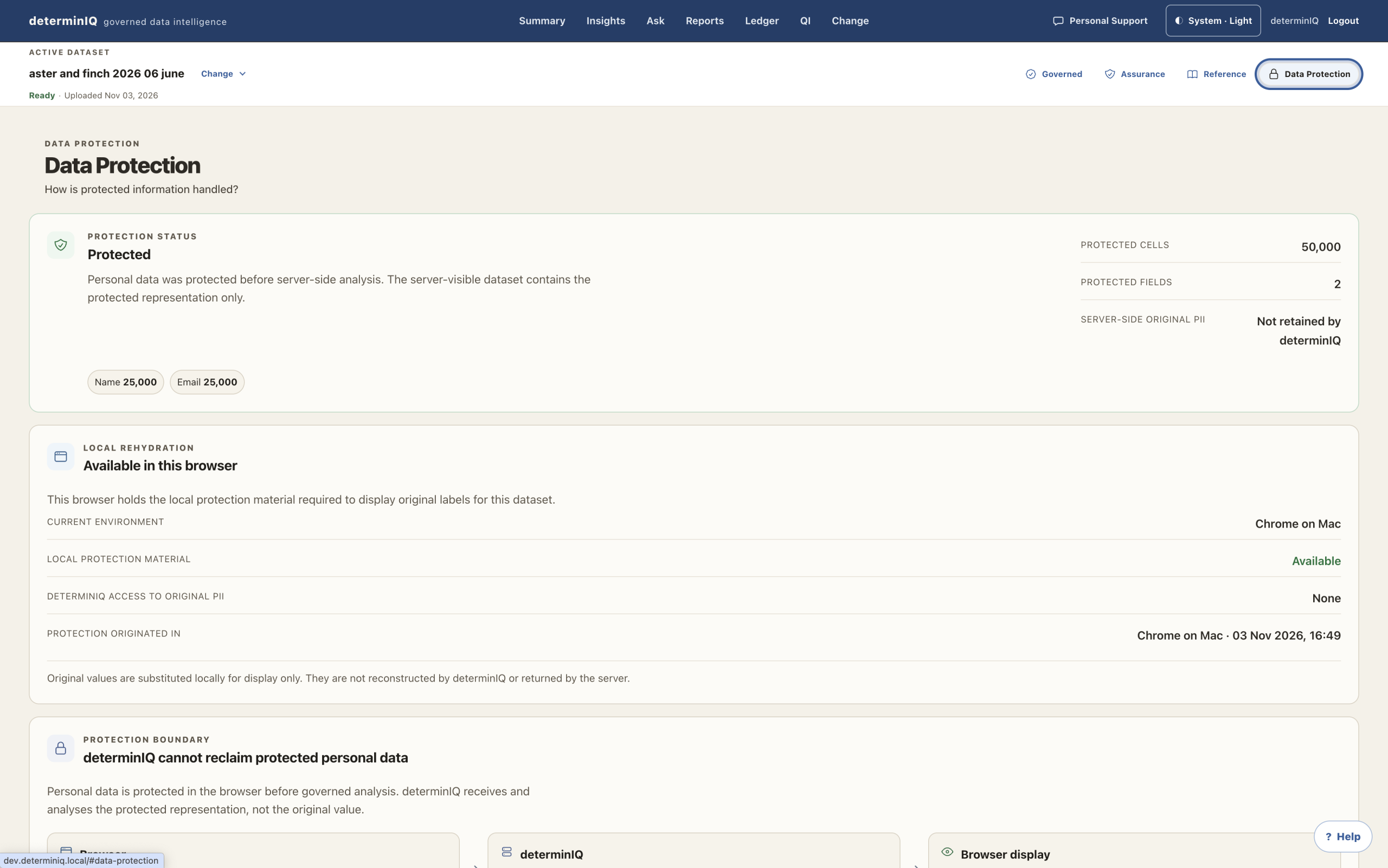
Designing the experience also meant making privacy boundaries practical. In the synthetic Aster & Finch example, the Data Protection view records 50,000 protected cells across name and email fields. Protection and any permitted browser-local revealing of values have different responsibilities.
That is both a user-experience and an engineering concern. A value protected at ingestion should not casually reappear through another view, chart or export. This screenshot illustrates the application’s handling of the example dataset; it is not an independent security or regulatory-compliance assessment.
From the first idea to the complete product
determinIQ required more than implementing analytical functions. I developed its product direction, brand and interface, designed architectural boundaries, directed and undertook engineering work with GPT, reviewed the resulting implementation, investigated failures and repeatedly tested and refined the behaviour.
The significant aspect of that process is the continuity of responsibility. A design choice affects the architecture; an architectural boundary affects the experience; evidence requirements affect reporting; privacy decisions must survive every stage. Those relationships cannot be resolved by treating the product as disconnected screens or technical tasks.
What this demonstrates about my work
I can take an unfamiliar, difficult problem from its original intention through product design, systems architecture, practical implementation and verification, keeping the purpose and responsibilities connected. That capability is relevant to many kinds of product and technology challenge, not only data analytics.
Project context
Project stage: Working implementation
Research programme: From intention to implementation: human-directed AI-assisted engineering
Topic: AI-assisted engineering
Explore further
Further reading is listed below.