On this page
Questions you could ask me
Questions you could ask me
What might earlier experience tell us today?
Or describe your own challengeWordServer was a commercial content management product that grew out of my earlier publishing work for Members of Parliament. I developed it with my team, retained its intellectual property and took it to a wider customer base.
By 2007, the platform faced substantial redevelopment to meet changing expectations for the web and mobile devices. I had a clear architectural choice: invest further in technology we owned, or use a mature platform and direct more effort towards the applications our customers actually needed.
I chose the second route for my subsequent work. WordServer continued as a commercial product; the decision was about where to put my development effort next, not a repudiation of what we’d built.
Making publishing accessible
The original work came from a straightforward observation: many people who needed to publish information online had neither the technical knowledge nor the desire to learn how websites worked.
Working with my team, I helped develop technology that allowed people to concentrate on the content they wanted to communicate.
The approach was used in parliamentary publishing work, including trials with selected MPs, and subsequently evolved into WordServer, a more general content management system.
We retained the underlying intellectual property and developed the platform for a wider customer base.
What mattered most to me wasn’t the technology for its own sake. It was making something complicated sufficiently straightforward for people to use confidently.
That remained a recurring principle in my work.
WordServer as a commercial product
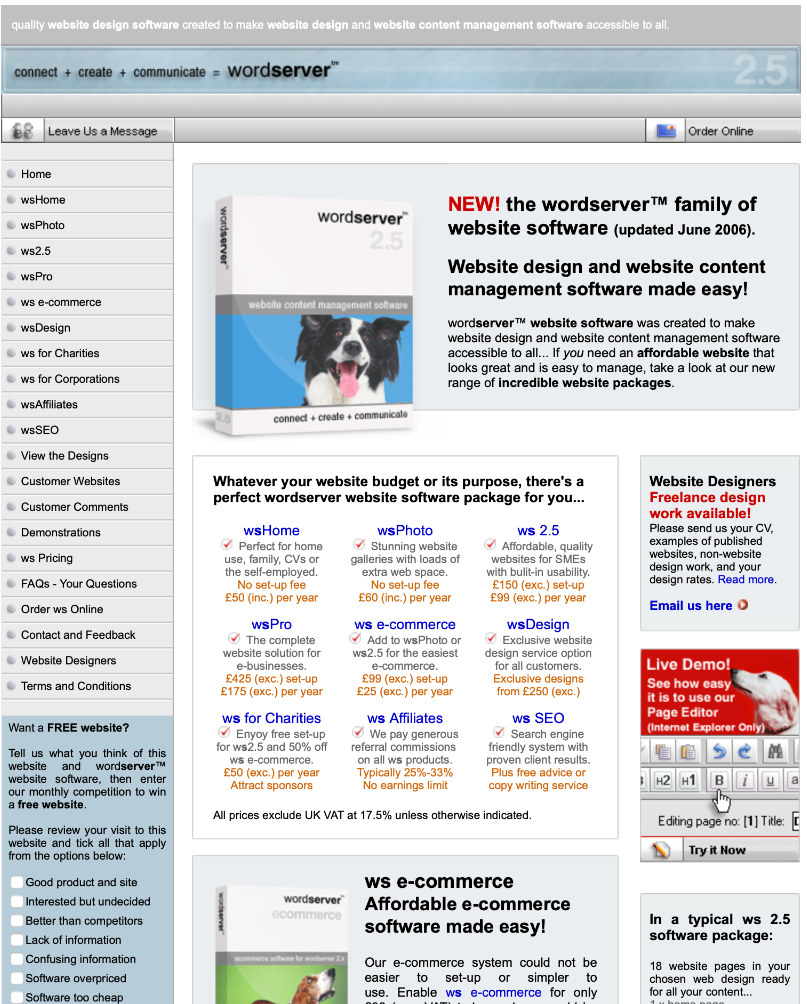
The original WordServer website survives in several historical captures, including material from the mid-2000s and later. They show a software product offered in distinct editions, with demonstrations, e-commerce functionality, pricing and customer support. Its marketing pages also included named customer testimonials.
That contemporary material is useful because it establishes that WordServer was more than an internal tool or an experimental publishing system. It had been packaged and presented commercially, with real client relationships behind its development. The published testimonials are evidence of what customers said in the company’s own material, not independent certification.
My decision in 2007 concerned where to focus my own future development effort. It did not mean the WordServer product disappeared that year. Later archived pages still show it being represented commercially.
When maintaining ownership becomes a liability
Owning a software platform has advantages. You control its direction, implementation and development priorities.
But ownership also comes with responsibility.
You have to maintain the underlying architecture, accommodate changing technologies, address security issues and continue investing in capabilities that customers increasingly take for granted.
By 2007, WordServer faced a significant redevelopment effort.
Meanwhile, WordPress had developed into an increasingly flexible and well-supported platform.
I looked at what it offered and asked myself a simple question.
Why reinvent the wheel?
We had already proved that we could design, build and sell a content management system. The better commercial and engineering decision was to concentrate on the products and experiences we wanted to deliver next.
So I changed direction.
Learning to use an established platform properly
Adopting WordPress wasn’t simply a matter of installing it and building websites.
I took the time to understand how to develop professionally with it: its architecture, extension mechanisms, data structures and the opportunities it offered beyond publishing.
That distinction matters.
A content management system can be used as a finished product, or it can provide a foundation on which more substantial applications are developed.
I became interested in the second possibility.
Over the years, I’ve developed hundreds of WordPress websites and a smaller number of more sophisticated applications.
One of those was a substantial workflow-management application using WordPress Multisite, supporting multiple customers through a shared application core.
This wasn’t simply a website with additional forms. It was an application using an established platform as part of its engineering foundation.
Some people found that surprising.
I didn’t see why the technology should be dismissed merely because it was commonly associated with websites.
The question was whether it could support what I needed to build.
Knowing what not to build
There is a tendency in software engineering to associate sophistication with complexity.
A bespoke framework may appear more impressive than an established platform. A custom implementation may seem more technically ambitious than using functionality that already exists.
But I don’t believe unnecessary complexity is an achievement.
Sometimes building something yourself is entirely justified. The requirements may be unusual, existing solutions may impose unacceptable constraints, or the system may need capabilities that cannot be provided reliably in another way.
At other times, the more difficult decision is to stop building technology you already own.
That requires putting the needs of the project ahead of any personal attachment to the implementation.
I had invested considerable effort in WordServer. I valued what we’d achieved.
But I didn’t regard continuing to develop it as an obligation.
Architecture is a series of decisions
Looking back, the move to WordPress was not a rejection of proprietary development.
Nor was it an endorsement of using an existing platform for every possible application.
It was a decision made in the circumstances of the time, based on the options available and the work I wanted to pursue.
I still use WordPress today, and I continue to evaluate other technologies in the same way.
What is the actual problem? What already exists? What are the constraints? What will be required to maintain the result? Where will our engineering effort create the greatest value?
Those questions are more useful than asking which technology happens to be fashionable.
The lesson I took from WordServer was simple.
Knowing how to build something is not, by itself, a reason to build it.
Good engineering also means recognising when the right foundation is already there.
Historical context
Topic: Content management
Explore further
Further reading is listed below.